
Views: 0 Author: Site Editor Publish Time: 2025-12-19 Origin: Site


You have likely spent a rainy Sunday afternoon hunched over a table, sorting through hundreds of cardboard pieces. There is a specific satisfaction in finding two shapes that lock together perfectly. But as you pieced together that landscape or famous painting, did you ever stop to ask: Why is it actually called a jigsaw puzzle?
It is a valid question. After all, most of us don't own a power tool called a jigsaw, and the puzzles themselves don't look like saws. The answer takes us back to the 18th century, involving a mapmaker, a specific woodworking tool, and a massive shift in how we manufacture games.
Understanding the history gives you a new appreciation for every piece you connect. Here is the story behind the name and how wholesale jigsaw puzzle manufacturers have evolved the process from hand-cutting wood to modern mass production.
The term "jigsaw puzzle" is actually a reference to the tool used to create them—though there is a historical twist.
When puzzles first became popular in the late 1700s and early 1800s, they weren't called jigsaw puzzles. They were known as "dissected maps." These early versions were educational tools designed to help the children of wealthy families learn geography.
The name "jigsaw" didn't emerge until the late 19th century. It coincided with the invention of the treadle saw, also known as a scroll saw or a jigsaw. This tool allowed for intricate curves and rapid cutting patterns that hand saws couldn't easily achieve. Because manufacturers began using this specific machine to cut the pieces, the products became known as "jigsaw puzzles."
Interestingly, the very first puzzles were not cut with a jigsaw at all. They were cut using a marquetry saw or a hand-held fretsaw. The name "jigsaw" stuck because it defined the era when puzzles moved from being expensive educational tools to affordable mass entertainment.

Credit for the commercialization of the puzzle goes to John Spilsbury, a British cartographer and engraver. Around 1760, Spilsbury pasted a map of Europe onto a thin piece of wood. He then cut along the borders of the countries.
The idea was simple but brilliant: if children had to physically put the countries back together, they would remember where they belonged. Spilsbury’s "dissected maps" were an instant hit among the British elite, including the Royal family.
However, these early iterations were strictly for the wealthy. They were made of mahogany or cedar and hand-painted. It wasn't until manufacturing methods changed that the jigsaw puzzle became a household staple.
The transition from wood to cardboard transformed the industry. In the early 20th century, companies realized that using die-cutting machines on cardboard sheets could drastically lower costs.
While artisan wooden puzzles are still cut using saws (or lasers in modern times), the mass-market puzzles you buy today are made differently.
Printing: A high-resolution image is printed onto special paper.
Mounting: This paper is glued onto a sturdy backing board (often called "blueboard" for its quality).
Die-Cutting: This is where the magic happens. Instead of a saw, wholesale jigsaw puzzle manufacturers use a massive hydraulic press. A "die" acts like a giant cookie cutter with sharp metal ribbons bent into the shape of puzzle pieces. The press slams down with tons of pressure, cutting all 1,000 pieces instantly.
This shift allows manufacturers like Yang & Yan Puzzles to produce up to 50,000 sets per day with incredibly low missing piece rates—a feat that would be impossible with the old hand-cutting methods.
The definition of a puzzle has expanded well beyond Spilsbury's map of Europe. Today, technology allows for various materials, shapes, and difficulty levels.
Here is a breakdown of the different types of puzzles available on the market today:
Puzzle Type | Description | Best For |
|---|---|---|
Standard Jigsaw | The classic flat puzzle made from cardboard or wood. Available in 300, 500, 1000, or 2000 pieces. | Hobbyists, families, and casual relaxation. |
3D Puzzle | Pieces fit together to form a standing structure, such as a globe, building, or animal. | People who enjoy model building and architecture. |
Floor Puzzle | Features extra-large, thick pieces designed for durability. | Young children and toddlers developing motor skills. |
Mini Puzzle | Tiny pieces (often 150 pieces in a test tube) that require tweezers or nimble fingers. | Travelers or experts looking for a quick, difficult challenge. |
Photomosaic | Thousands of tiny images tile together to create one larger image. | Advanced puzzlers who want a high difficulty level. |
In an era of smartphones, VR, and high-definition video games, the humble jigsaw puzzle has not only survived—it has thrived. Why?
It comes down to the way our brains work. Puzzles induce a state of "flow." When you are scanning for a specific shade of blue to finish the sky, your brain shuts out other stressors. It is a form of active meditation.
Furthermore, finishing a puzzle releases dopamine. That small "click" when a piece fits provides a sense of order and accomplishment that is often missing in our chaotic digital lives.
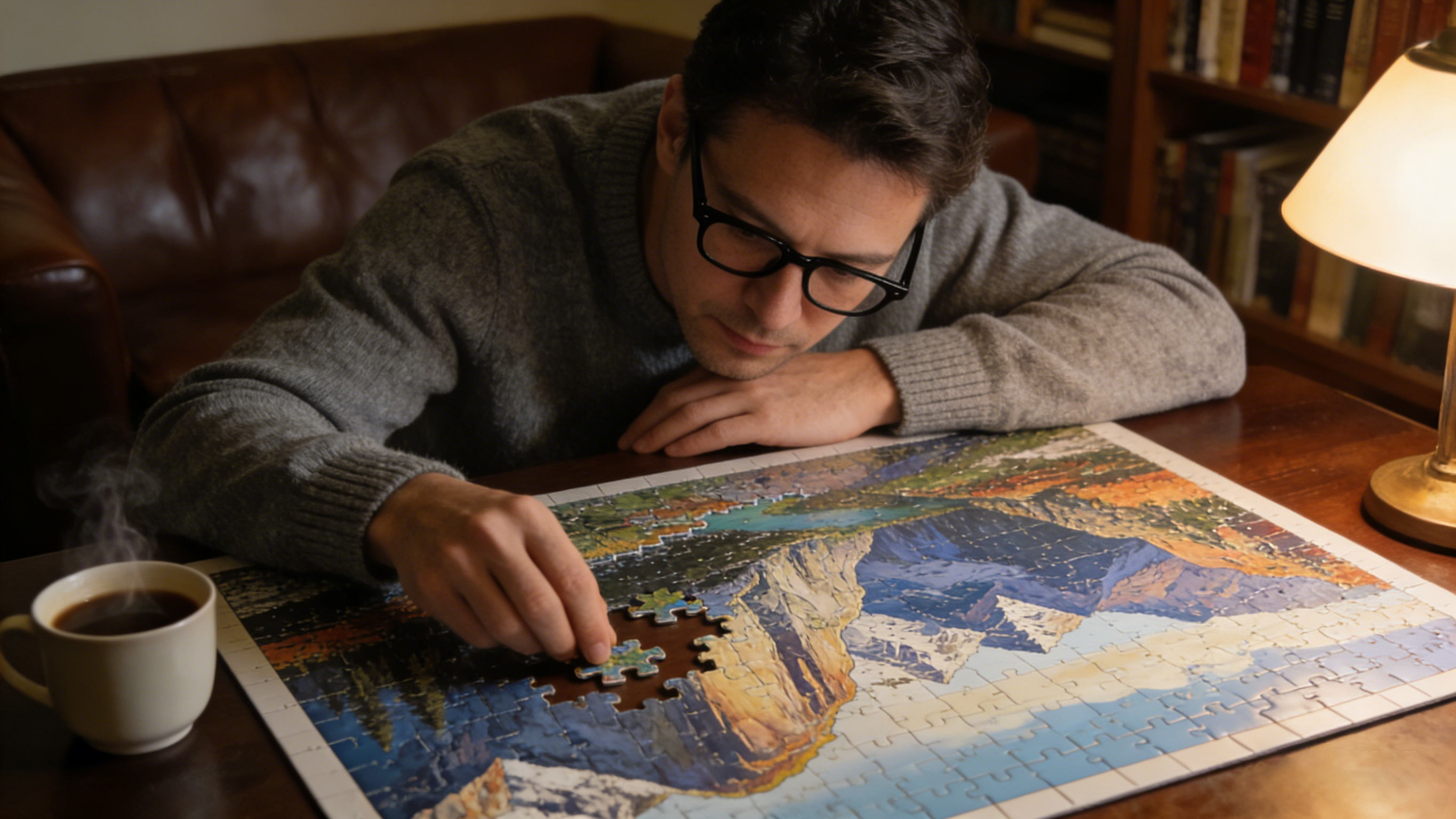
To help you understand more about the world of tiling puzzles, we have answered some common questions below.
Yes, generally speaking. "Picture puzzle" is a broader term that can include logic games or "spot the difference" images. However, if the picture is broken into interlocking pieces that need reassembly, it is a jigsaw puzzle.
The classic shape is called a "fully interlocking" cut. The loops and sockets (often called "keys" and "locks" or "innies" and "outies") are designed to hold the puzzle together so it doesn't slide apart on the table. Early puzzles didn't always interlock; if you bumped the table, your map of Europe would be ruined!
Absolutely. Modern manufacturing allows for high levels of customization. Whether you are a business looking for branded merchandise or an artist wanting to sell your designs, wholesale jigsaw puzzle manufacturers can create custom OEM/ODM orders. You can choose the piece count, box art, and material.
While piece count matters (5,000 is harder than 500), the image is usually the deciding factor. A 500-piece puzzle that is entirely one color (like "White Hell") is often harder than a 2,000-piece puzzle with a distinct, colorful image.
The jigsaw puzzle has come a long way from a geography lesson for 18th-century children. It was named after a saw, revolutionized by the industrial press, and remains a beloved pastime across the globe.
Whether you are a casual fan or a business looking to source high-quality games, understanding the production quality is key. From the sharpness of the die-cut to the quality of the backing board, manufacturing matters.
If you are interested in creating your own line of puzzles, or need a reliable supplier for board games and greeting cards, professional manufacturing is essential.
Ready to create your own masterpiece?
Contact Yang & Yan Puzzles today. With over 10 years of experience and advanced automated machinery, we provide premium OEM/ODM services to help bring your puzzle ideas to life.


