
Views: 0 Author: Site Editor Publish Time: 2025-12-02 Origin: Site


There is a specific ritual that unites jigsaw enthusiasts everywhere. It begins the moment you break the seal on the box. You dump the pieces onto the table, savoring the clatter of cardboard, and immediately start the hunt. You are looking for the flat edges.
Building the frame is the standard first step for most puzzlers. It provides structure, scale, and a sense of accomplishment before you tackle the chaotic middle. But there is a common frustration that arises during this process. You have sorted through the pile three times, yet your frame has a gap. You are convinced a piece is missing.
Before you scour the floor or accuse the vacuum cleaner, it helps to know exactly what you are looking for. How many edge pieces should there be? The answer lies in a mix of geometry and manufacturing standards.
Most people assume a 1000-piece puzzle contains exactly 1000 pieces. Surprisingly, this is rarely true.
Because puzzles are typically cut into a grid of pieces, the total number must be the product of the number of pieces along the height and the width. It is impossible to create a perfect rectangle using exactly 1000 square-ish pieces because 1000 does not factor into a pleasing rectangular ratio (like 4:3 or 3:2).
To get as close to 1000 as possible while maintaining a standard rectangular shape, puzzle manufacturers usually use a grid of 40 pieces by 25 pieces.
Here is the math:
40 x 25 = 1000 pieces.
To find the number of edge pieces in this specific grid, we calculate the perimeter:
Top and Bottom Rows: 40 + 40 = 80 pieces.
Left and Right Columns: 25 + 25 = 50 pieces.
Total: 130 pieces.
However, if you just add the sides, you are counting the four corner pieces twice (once for the row, once for the column). So, we must subtract 4.
130 - 4 = 126 edge pieces.
1
While 40x25 is the most common grid, it is not the only one. Some manufacturers prefer a slightly different aspect ratio, resulting in a total piece count of 1,008 (typically a 28x36 grid).
If your puzzle is a 28x36 grid:
Perimeter: (28 + 28 + 36 + 36) = 128.
Subtract corners: 128 - 4 = 124 edge pieces.
So, if you have found 124 edges and the frame connects perfectly, you aren't missing anything. You just have a 1,008-piece puzzle.
The math changes significantly if you are working on a panoramic puzzle. These puzzles are much wider than they are tall, which alters the perimeter calculation.
Let’s imagine a panoramic puzzle that is still roughly 1000 pieces. A grid might be 20 pieces high by 50 pieces wide (Total: 1000 pieces).
Perimeter: (20 + 20 + 50 + 50) = 140.
Subtract corners: 140 - 4 = 136 edge pieces.
As the puzzle becomes longer and thinner, the number of edge pieces increases relative to the interior pieces.
The popularity of custom 1000 piece puzzles has surged recently. People love turning family portraits, pet photos, or art prints into challenging activities. When ordering a custom puzzle, the manufacturing process determines your edge count.
Most high-quality custom puzzle makers utilize a "ribbon cut." This is the standard cut where pieces are aligned in rows and columns, making the math we discussed above applicable. If you order a standard rectangular custom puzzle, you can generally expect that same 126-piece count.
However, some custom manufacturers use a "random cut" (sometimes called Victorian cut). In these puzzles, the pieces are not arranged in a neat grid. They vary wildly in shape and size, and the corners might not even meet at perfect right angles. In random-cut puzzles, predicting the exact number of edges is nearly impossible without counting them one by one, though the total will still likely hover between 120 and 130.
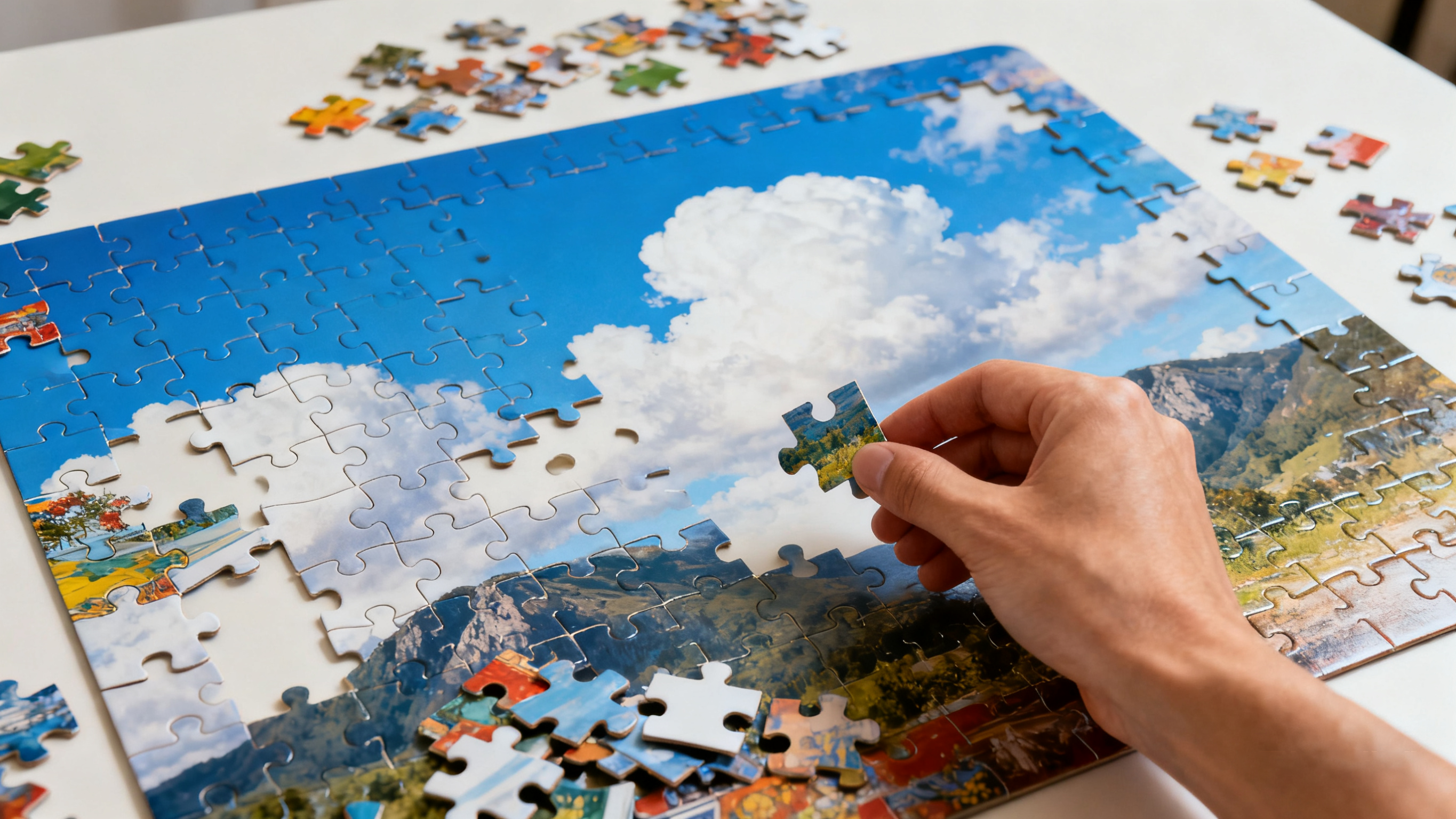
You have counted 125 pieces. You know there should be 126. The frame has a single gap. This is the bane of the puzzler’s existence. Before you assume the piece was lost to the sofa cushions, consider that you might have simply missed it during the sorting process.
Here is why edge pieces are easily overlooked:
Some die cuts are tricky. A piece might have a side that is almost flat but has a very slight curve or a tiny nub. Conversely, an interior piece might be cut so close to the edge of the image that it looks like a border piece at a glance.
When sorting through a thousand pieces, your eyes can glaze over. If the border of the image is dark or has a complex texture (like grass or sky), an edge piece can easily blend in with the interior pieces.
If you are stuck at 125, stop looking for the specific shape of the missing hole. Instead, sift through your "middle pieces" pile again. Run your finger along the edges of potential candidates. Sometimes your sense of touch finds the straight edge faster than your eyes.
If you have completed the frame and the math confirms you are short a piece, don't panic.
Check the floor and box: It sounds obvious, but pieces often get stuck under the box flaps or drop unnoticed.
Check the vacuum: If you cleaned recently, the canister is a prime suspect.
Count the grid: Once you have more of the puzzle assembled, count the number of pieces across the top and down the side. Do the math (2xHeight + 2xWidth - 4). This will confirm exactly how many edges you should have.
Contact the manufacturer: Many reputable brands, including those that make custom 1000 piece puzzles, offer piece replacement policies.
1
Completing the border is the first victory in the long campaign of finishing a jigsaw puzzle. Knowing that you are looking for exactly 126 pieces (in most cases) gives you a concrete goal. It turns the vague anxiety of "do I have them all?" into a solvable math problem.
So, next time you pour out that box of 1000 pieces, remember the number 126. It might just save you from searching for a piece that isn't there, or help you realize that the final piece of the frame is hiding in plain sight.


